When Fear Is Running Your Business
(And How to Recognize It in Real Time)
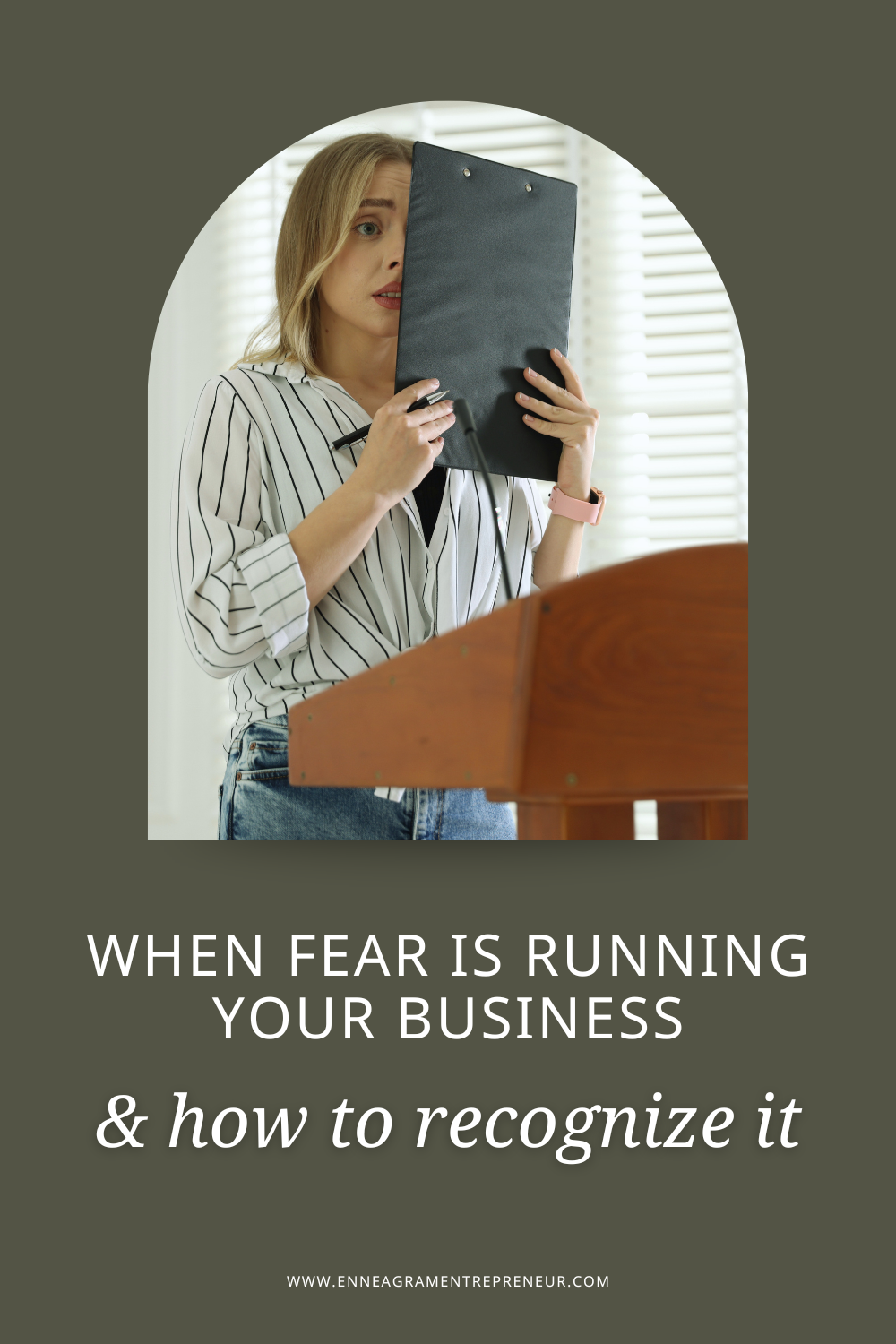
Late last year, I was deep in a branding project that had quietly gone sideways.
My client kept changing the direction of the design, after I had already done multiple rounds of mockups. And every time it happened, I told myself the same thing: She already paid you. You keep going until she's happy.
It sounded reasonable. Responsible, even. Like I was just doing my job.
What it actually was was fear.
Fear that if I said something, she would be upset. That she would want her money back. That the whole relationship would fall apart. So I kept working, kept accommodating, and watched resentment quietly build in the background until one day she changed direction again, and something in me hit a wall.
I finally said something. Nicely, but clearly.
She took it completely fine.
Which, if I am honest, is almost always how it goes. That is the thing about being a Type Nine: the conflict I had been bracing for felt so certain and so catastrophic that I had worked myself into a bad mood just to avoid it. But it never actually materialized. It lived almost entirely in my head, dressed up in reasonable explanations.
That is what fear does. It does not announce itself.
It hands you a justification and lets you believe you are just being practical.
What Does Fear Look Like in a Business Context?
Fear in business is the quiet force behind decisions that seem logical on the surface but don't actually move you forward.
It's not the dramatic "I'm terrified to do this" feeling. It's the undercurrent.
The thing that makes you spend three weeks perfecting your website before launching it. The reason you drop your price when someone seems hesitant. The explanation for why you've been meaning to send that email to your list but haven't quite gotten around to it.
Fear-driven business decisions have a specific texture to them. They feel like protection. They feel like due diligence. They feel like being responsible.
But they're quietly keeping you where you are.
Here's a practical way to start distinguishing fear-driven decisions from genuinely strategic ones: ask yourself what would happen if you were certain it would work. Would you still be doing as much research? Would the timeline be the same? Would you be adding more steps, or fewer?
When fear is running the show, the process gets longer. The bar keeps moving. There's always one more thing to figure out before it's time to go.
How Fear Shows Up for Each Enneagram Type
This is where the Enneagram becomes genuinely useful. Fear doesn't look the same for everyone — it takes a very specific shape depending on your type. And the more precisely you can name your version of it, the more quickly you can catch it.
Type 8
Type 8 fears being controlled, manipulated, or made vulnerable.
In business, this produces a specific kind of isolation: the refusal to ask for help, the resistance to any structure that feels like someone else's rules, the tendency to run the whole thing alone because depending on anyone else is a form of risk.
The 8's strength is real. But the fear underneath it keeps them from the kind of collaboration and support that would actually accelerate them.
Type 9
Type 9 fears conflict, disruption, and the loss of connection that comes from asserting themselves too much.
In business, this shows up as inertia — the muted urgency around their own vision, the inability to have the conversation that needs to happen, the business that stays comfortable long past the point where comfortable is serving anyone.
The 9's fear doesn't feel like fear. It feels like not wanting to cause trouble.
Type 1
Type 1 fears being wrong, imperfect, or criticized.
In business, this shows up as the offer that never feels ready to launch, the email that gets revised fourteen times, the service page that's been "almost done" for two months. The 1 isn't being lazy or indecisive — they're protecting themselves from the possibility of getting it wrong in public.
The fear isn't loud. It sounds like standards.
Type 2
Type 2 fears being unwanted — specifically, being unloved once the usefulness runs out.
In business, this shows up as undercharging, over-delivering, and saying yes to clients who aren't quite right because turning them away feels like risking rejection.
The 2 doesn't experience this as fear. It feels like generosity, or like being a good person. But the price of that "generosity" compounds.
Type 3
Type 3 fears being seen as a failure or — more precisely — being exposed as someone whose worth was never really there.
This produces a particular kind of business fear: not the fear of doing things wrong, but the fear of stopping long enough to find out who they are without the results.
The 3 keeps moving, keeps achieving, keeps launching — because slowing down is where the vulnerability lives.
Type 4
Type 4 fears being ordinary or being deeply misunderstood.
In business, this tends to produce a specific kind of visibility block: the 4 wants to be seen, but seen accurately, which means generic visibility feels worse than no visibility at all. They'd rather not post than post something that flattens what their work actually is.
The fear isn't of being judged — it's of being reduced to something that isn't true.
Type 5
Type 5 fears being depleted, overwhelmed, or found incompetent.
In business, this shows up as over-research before action, difficulty offering before they feel like they know enough, and a persistent sense that they need more preparation before they're ready to be seen as an expert.
The 5's fear keeps them in the accumulation phase long past the point where they have more than enough to offer.
Type 6
Type 6 fears that things could fall apart, that people can't be trusted, and that the ground might not hold.
In business, this produces what looks like strategic caution but functions more like an inability to commit. The 6 can see every possible way something could go wrong, and that vision keeps pulling their attention away from what's actually likely.
Analysis paralysis is the 6's fear wearing a planning costume.
Type 7
Type 7 fears being trapped, deprived, or stuck with pain they can't escape.
In business, this shows up not as hesitation but as its apparent opposite: constant pivoting, new ideas replacing old ones before anything has compounded, the inability to stay with one thing long enough for it to work.
The 7's fear doesn't look like fear — it looks like enthusiasm. But the enthusiasm is partly an escape route.
How to Recognize It in Real Time
The most useful skill you can develop is the ability to pause mid-decision and ask a different question.
Instead of asking "is this the right move?" — which is the strategy question — ask "what am I protecting myself from?"
Not every hesitation is fear. Not every delay is avoidance.
But when the answer to "what am I protecting myself from?" lands with some recognition — when it names something real — that's information worth sitting with.
A few real-time signals that fear is involved:
You feel relief when something falls through.
A potential client goes quiet, an opportunity doesn't pan out, someone says no — and underneath the surface disappointment, there's a small exhale. That relief is telling you something.
The work feels heavier right before visibility.
You can work on something for weeks in private with no problem, but the moment it's almost ready to share, it suddenly needs more work. More edits. One more pass.
You make decisions based on what others will think.
Not "is this right for my business," but "what will people say," or "will they think I'm serious," or "will she think I'm charging too much." When the audience in your head is making your decisions, fear is usually driving.
You keep moving the deadline.
The launch date gets pushed. The email gets saved to drafts. The offer page has been "almost done" for two months. The deadline moves not because circumstances changed, but because there was never a real commitment underneath it.
What to Do With This Fear
The goal isn't to eliminate fear. Fear is information. Sometimes it's pointing to something real that deserves attention.
But there's a meaningful difference between fear that signals genuine risk and fear that signals the risk of being seen.
The first step is simply naming it. Not analyzing it to death, not journaling about it for an hour, but just pausing long enough to say: "Oh. This is fear." Something shifts when you name it, even quietly, even just to yourself.
The second step is asking whether the fear is proportional. What is the actual worst case here? Not the catastrophized version, but the real one. Usually it's survivable. Usually it's recoverable. Usually the risk is much smaller than the feeling.
The third step is what distinguishes people who move through it from people who stay stuck: taking one concrete action in the direction of the thing you've been avoiding.
Not a huge leap. Just a step. Send the email. Schedule the post. Set the price. See what happens.
Fear tends to lose its grip the moment you act despite it.
Not before. After.
Final Thoughts
Fear is one of the most underacknowledged forces in small business. We talk about strategy, about systems, about marketing — and those things matter. But underneath most of the decisions that aren't working, there's usually something quieter at work.
The businesses that grow aren't run by people without fear. They're run by people who've learned to notice when fear is driving and gently, persistently, choose differently.
Your type doesn't make you destined to stay stuck. It just tells you exactly where to look.